Upgrading power in an older warehouse: when the original install gives out
Old switchboards, undersized circuits and no three-phase capacity can stall a growing warehouse. Here's what a power upgrade actually involves under AS/NZS 3000.
Quick answer
If your warehouse switchboard is old, circuits are tripping under load, or you’re adding machinery that the original install wasn’t designed for, you need a proper demand calculation and likely a full distribution board upgrade — done by a licensed electrician, certified with a CoES, and compliant with AS/NZS 3000. Don’t patch around an undersized install. Fix the root cause.
The problem with original warehouse installs
A lot of warehouses across Melbourne’s industrial corridors — suburbs like Thomastown and Epping that grew up through the 1970s and 1980s — were wired for the equipment of that era. A switchboard designed for a handful of single-phase circuits and a couple of fluorescent lighting runs was perfectly adequate when the building was built. It is not adequate for a modern operation running refrigerated cool rooms, automated conveyors, compressed air systems and electric forklifts.
The original install doesn’t fail all at once. It fails slowly, in ways that look like equipment problems: machines that struggle to start, lighting that dims when a motor kicks on, circuits that trip for no obvious reason. By the time the main switch starts to warm up or breakers are tripping weekly, you’re already behind where you should have been.
That’s not a criticism — it’s just how buildings age when the operation inside them outgrows the shell.
What a demand calculation actually tells you
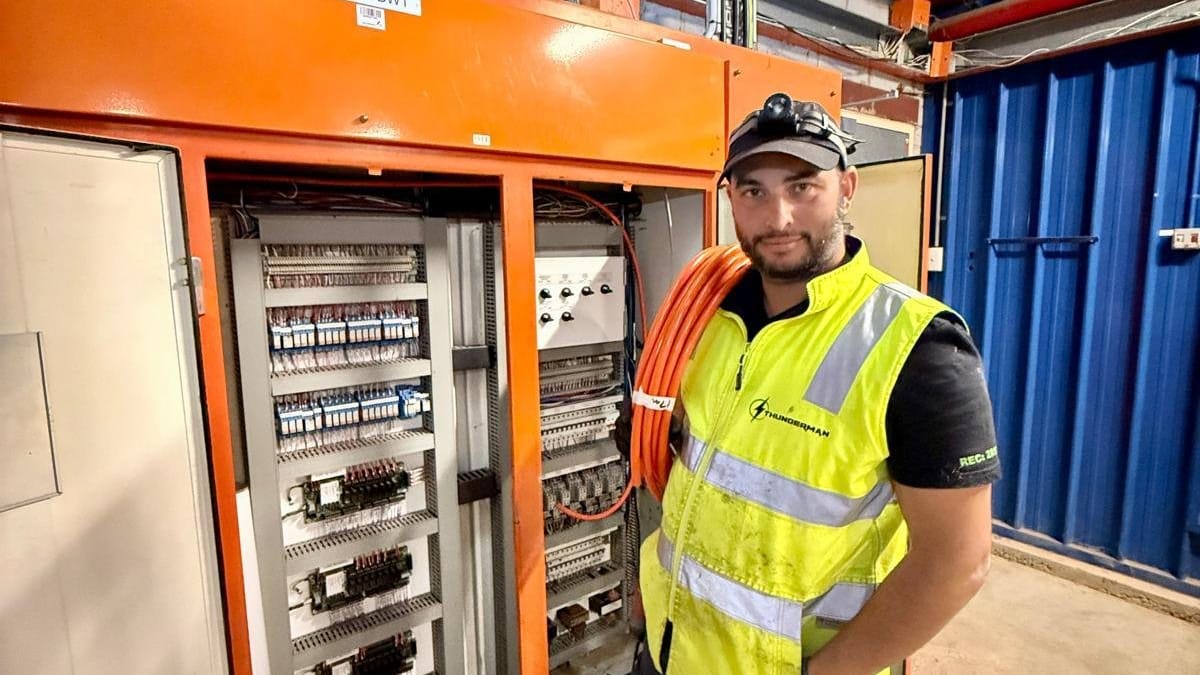
Before any switchboard work starts, a licensed electrician needs to know what you’re actually running. This isn’t guesswork. It’s a calculation that adds up your connected load — every motor, heating element, lighting circuit, and fixed piece of plant — and applies diversity factors to work out the realistic maximum demand at any one time.
AS/NZS 3000 sets out the methodology. The result tells you the minimum rating your main switch and distribution board need to handle, how your sub-boards and circuits should be arranged, and what size supply you need from your network distributor (in Victoria, that’s Ausnet, United Energy, Jemena, Powercor or CitiPower depending on your area).
If the calculation shows your current supply is undersized, that’s a conversation with your distributor — a network application, not just an electrical job. That process can take weeks, so it’s worth knowing early rather than after the switchboard is already on order.
Distribution boards: age, condition, and what to look for
A switchboard isn’t just a box of breakers. It’s the organisational centre of your electrical install — the point where the incoming supply is divided, protected and distributed to every circuit in the building. When it’s old, undersized, or poorly documented, every decision that flows from it is compromised.
In older industrial buildings, watch for:
- Rewireable fuses still in place (ceramic fuse carriers with wire elements, not modern circuit breakers). These offer no overload protection worthy of the name and no safety switch function.
- No RCDs (safety switches) on circuits feeding workspaces. Under AS/NZS 3000, certain circuits — particularly those in areas where people work with portable equipment — require RCD protection.
- No spare capacity in the board itself. If every slot is full and circuits are already shared between loads they weren’t designed for, you’re one machine addition away from a real problem.
- Unlabelled or incorrectly labelled circuits. In a busy warehouse where someone’s eventually going to isolate a circuit in a hurry, wrong labels are a safety issue, not just an inconvenience.
- Signs of heat damage: discolouration around terminals, melted insulation on cable tails, breakers that feel warm to the touch even under light load. These are red flags. Switch off the supply to that board if it’s safe to do so, and call a licensed electrician before using it further.
Three-phase loads and why they matter in a warehouse context
Single-phase power (240V, one active conductor) works fine for lighting, power points, small tools and office equipment. It doesn’t work well — or at all — for most industrial machinery above a few kilowatts.
Three-phase power (415V across phases, three active conductors) is what industrial motors are designed to run on. It starts more smoothly, runs more efficiently, and doesn’t cause the voltage sag that single-phase loads can produce when a big motor kicks in. If your warehouse has a compressor, a refrigeration plant, CNC machines, large dust extraction or any kind of production line, three-phase isn’t optional — it’s the correct supply for those loads.
If the building only has a single-phase supply, upgrading to three-phase means a distributor application and a new point of attachment. That’s separate from (and usually happens before) the internal switchboard work.
Once three-phase is available at the board, the internal work involves distributing it correctly to sub-boards and individual machine circuits — with the right cable sizes, the right protective devices, and correct phase balancing so you’re not overloading one phase while the others sit light.
For commercial and industrial work of this kind, the design and installation both need a licensed electrician. This isn’t a job where the scope is obvious from the outside; it opens up as you go, and the person doing the work needs to be able to adapt the design to what they find.
Machine isolators: the detail that often gets missed
AS/NZS 3000 requires fixed plant and machinery to have a means of isolation that is:
- Accessible at or near the machine (not just at the main board, two hundred metres away)
- Lockable, where practicable, so maintenance can be done safely
- Clearly identified — labelled with what it isolates
In older warehouses, this is one of the most common compliance gaps. Equipment has been moved, extended, re-plumbed, connected to different circuits — and the isolation arrangements haven’t kept up. You end up with a machine that nominally has an isolator, but it’s the wrong rating, it’s in the wrong place, or the label reads something that doesn’t correspond to anything currently installed.
Getting isolators right matters most when something goes wrong. A tradesperson, a forklift driver, a maintenance worker — anyone who needs to make the machine safe before touching it needs to be able to do it quickly and reliably. A missing or wrong isolator turns that into a guessing game.
As part of any distribution board upgrade, it’s worth auditing the isolation arrangements for all fixed plant at the same time. The board work gives you a natural point of intervention.
What the certification process looks like
Every installation or alteration of electrical work in Victoria requires a Certificate of Electrical Safety (CoES), issued by the licensed electrician who performed the work. This is not optional and it’s not bureaucratic box-ticking — it’s the record that the work was done to the standard, by someone authorised to do it.
You can verify that your electrician is a Registered Electrical Contractor on the ESV public register. Yiannis holds REC 28523. For work of this scale — a distribution board replacement, new three-phase circuits, machine isolator installation — you should expect to receive a CoES for the work, and you should keep it with your building records.
If you’re leasing the premises, your landlord may also have obligations around electrical safety. Worth clarifying that before work starts so both parties know what’s being certified and what records are being kept.
What to do next
If your warehouse is showing any of the signs above — tripping circuits, machinery that struggles to start, a switchboard that looks like it predates the current operation — the right move is a site assessment, not a patch job.
Start by making a list of everything fixed and motorised in the building: rated kilowatts, single or three-phase, how often it runs, whether it’s likely to change in the next few years. That gives a licensed sparky the raw material to do a proper demand calculation before anyone opens a switchboard.
Don’t add new machinery to a circuit that’s already marginal. Don’t bridge a failing breaker. And if you see heat damage around any part of the switchboard, treat it as urgent.
For commercial and industrial electrical work across Greater Melbourne, Yiannis can do the site assessment, the demand calculation, and all the installation and certification work. If you’d rather a licensed sparky handle it, give Yiannis a call on 0434 254 474 or send a quick message for a free quote.
Sources
Common questions
How do I know if my warehouse switchboard is undersized?
The clearest signs are circuits tripping under normal load, machinery that won't start reliably, or a main switch rated well below your total connected load. A licensed electrician can do a proper demand calculation against your actual equipment list.
Does a warehouse power upgrade need a Certificate of Electrical Safety?
Yes. Any new electrical installation work in Victoria — including a new distribution board, additional circuits or machine isolators — requires a Certificate of Electrical Safety (CoES) issued by the licensed electrician who did the work.
What is three-phase power and does my warehouse need it?
Three-phase power delivers electricity across three conductors instead of one, giving you higher total capacity and more stable voltage for heavy motors. Most industrial machinery above a few kilowatts — compressors, conveyor drives, CNC equipment — is designed to run on three-phase. If your warehouse only has single-phase, you may need a supply upgrade from your distributor.
Do machine isolators have to comply with AS/NZS 3000?
Yes. AS/NZS 3000 (the Wiring Rules) requires that fixed plant and machinery be provided with a means of isolation that is accessible, lockable where practicable, and clearly identified. Getting this wrong is one of the most common defects found during industrial inspections.
Can I move machinery to a new part of the warehouse without touching the wiring?
Not safely in most cases. If the new location takes the machine beyond the reach of its existing circuit, or the circuit isn't rated for the load, the wiring must be extended or upgraded by a licensed electrician before the machine is reconnected.
Who licenses electricians in Victoria — ESV or the VBA?
Energy Safe Victoria (ESV) registers electrical contractors and issues REC numbers. The Victorian Building Authority (VBA) does not license electricians. You can verify any electrician's registration on the ESV public register.

The owner does your job
You'll get Yiannis — not a subcontractor.
Book Thunderman and the licensed electrician who quotes your job is the one who does it — and stands behind it afterwards. REC 28523, ARCtick certified, public liability insured, rated 4.9★ across 53 Google reviews.
More from the Journal
Got a follow-up question? Just call.
Free quotes across Greater Melbourne — Yiannis answers personally.