
ESV charges crane company after powerline contact seriously injures worker
Energy Safe Victoria has charged a crane company after a worker was seriously injured by powerline contact. Here's what it means for anyone working near powerlines in Melbourne.
Quick answer
Energy Safe Victoria has charged a crane company after a worker was seriously injured when the crane made contact with a powerline. Under Victorian electrical safety law, anyone operating plant or equipment near powerlines — from crane operators to construction site managers — has a legal duty to identify lines and maintain safe clearance distances before lifting anything.
What ESV announced today
This morning, Energy Safe Victoria published details of charges laid against a crane company following a serious powerline contact incident that left a worker with significant injuries.
ESV is Victoria’s electrical and gas safety regulator. When it lays charges under the Electrical Safety Act 1998, that’s not a warning letter — it’s a formal prosecution. The regulator doesn’t publicise every near-miss. When it goes public, the facts are serious enough that they want the industry to take notice.
The details of the specific worksite haven’t been fully disclosed pending proceedings, but the mechanism is familiar: a crane operating near overhead powerlines, insufficient clearance, contact made, worker seriously injured. It’s a scenario that happens more often than most people outside the trades realise, and ESV’s decision to prosecute signals exactly how preventable they consider it to be.
If you work in construction or plant operation anywhere in Greater Melbourne — including busy industrial corridors like Broadmeadows — this news is worth your full attention.
Why powerline contacts keep happening
Overhead powerlines are everywhere in Melbourne’s suburban and industrial landscape. Low-voltage lines serving residential streets, high-voltage distribution lines cutting across commercial properties, service connections dropping to individual buildings. Most of the time they sit there quietly doing their job, and it’s easy to forget they exist.
That’s the problem.
On a busy worksite, a crane operator is focused on the lift — the load, the rigging, the signal from the dogman on the ground. Overhead hazards require a separate, deliberate thought process, and that process has to happen before the machine moves, not when the arm is already up. ESV’s own guidance on working near powerlines is clear: identify every overhead line in the work zone before any plant is set up or moved, and get written authorisation from the network operator before working within the designated exclusion distance.
The clearances involved aren’t a matter of opinion. For standard low-voltage distribution lines (the ones over suburban streets), unqualified persons must stay at least three metres clear. For high-voltage transmission lines, the exclusion zone is considerably larger and varies by voltage level. These figures come from a body of Australian Standards and network operator requirements — not rough estimates.
The network operator — AusNet Services, Citipower, Powercor, United Energy or Jemena, depending on your Melbourne suburb — can issue a formal permit or arrange a line escort for work in proximity. That process takes time to arrange, which is exactly why it needs to be built into project planning, not treated as a day-of administrative task.
What the law actually requires in Victoria
Under the Electrical Safety Act 1998 (Vic), there is a general duty not to create a risk of electrical injury. That duty applies to everyone — not just to the person operating the plant, but to the employer, the principal contractor, and any person whose decisions affect how work near powerlines is planned and carried out.
For construction work, the intersection with the Occupational Health and Safety Act 2004 (Vic) and its regulations means that principal contractors have positive obligations to identify hazards — including overhead powerlines — in the project planning stage. A crane lift within proximity of a powerline should appear in a Safe Work Method Statement (SWMS) with specific controls documented. “We’ll be careful” is not a control.
ESV’s enforcement action today is a reminder that the regulator is active, it investigates incidents, and it is willing to use the full weight of prosecution when it determines that reasonable precautions weren’t taken. The charges haven’t been finalised, but the fact of prosecution itself carries weight in an industry where word travels fast.
This isn’t only a construction site issue
It’s tempting to read this news and think: that’s a crane company problem, not relevant to me.
Worth pausing on that. Powerline hazards aren’t confined to large construction sites. They come up in tree removal, roofing work, antenna installation, gutter cleaning with extension ladders, and even large vehicle movements on residential streets. In an older suburb with lots covering dense blocks, service connection cables can run surprisingly low and surprisingly close to buildings.
If you’re a homeowner planning any work near where your power service enters the property — the point where the network line connects to your home’s meter box and main switchboard — the same principle applies. That entry point is live, it belongs to the network, and working near it without proper isolation is not a job for anyone without the right licence and the right authorisation from the distributor.
For all residential electrical work at or near your home’s service connection, the short answer is: call a licensed sparky first. There’s a reason Victoria runs a registration system for electrical contractors through Energy Safe Victoria — the work is genuinely dangerous when it’s not done properly. Yiannis holds REC 28523 on that register, and you can look it up.
What to do if you’re planning work near powerlines
If you’re a homeowner or small business owner and you’ve got a project coming up that might bring any structure, vehicle, or equipment near overhead lines, here’s a practical sequence:
- Identify the lines. Look up, look across the site, look at neighbouring properties. Lines that serve a house across the road can still run directly over your site boundary.
- Contact your network distributor. Not your energy retailer — the distributor who owns the physical lines. They can tell you the voltage, the clearance requirements, and what’s required before work can proceed. In Melbourne’s north, that’s typically AusNet Services for the suburbs running through Broadmeadows and up to Craigieburn.
- Get it in writing. A phone conversation is not an authorisation to work near live lines. Get the permit or written direction from the network operator before work begins.
- Brief everyone on site. Not just the crane operator or the person at height. Everyone in the work zone needs to understand where the lines are and what the exclusion boundaries look like.
- If in doubt, stop. A project delay is recoverable. A serious electrical injury may not be.
For any electrical work on your home’s wiring, switchboard, or service connection that’s come up as part of a broader project, get that component quoted and scheduled separately by a licensed electrician before the other trades move in.
What to do next
If you’re a Melbourne homeowner with work planned near any overhead lines, or if today’s news has prompted you to check the service connection at your property, the right first call is to your network distributor to understand what’s running near your boundary.
For the electrical work inside your home — switchboard upgrades, safety switch installation, anything touching your fixed wiring — that’s where Yiannis comes in. If you’d rather a licensed sparky handle it, give Yiannis a call on 0434 254 474 or send a quick message for a free quote.
Sources
Common questions
What is the safe working distance from powerlines in Victoria?
Under AS/NZS 3000 and ESV guidance, no plant or equipment should approach a powerline without prior authorisation from the network operator. The required clearance distances vary by voltage — for standard low-voltage lines, unqualified persons must stay at least three metres away. Your network distributor (AusNet, Citipower, Powercor, etc.) can issue a formal permit to work near lines.
Who is responsible for powerline safety on a construction site?
Responsibility sits with the principal contractor and the operator of any plant or equipment — including crane operators. Under Victorian electrical safety law, everyone on site has a duty not to create a risk of electrical injury. That includes planning work to identify and avoid overhead powerlines before any lift begins.
Can a powerline contact injure someone who isn't touching the equipment directly?
Yes. When a crane or other plant contacts a live powerline, electrical energy can travel through the machine and into the ground in a wide radius — a phenomenon called step potential. Anyone standing nearby can receive a serious shock without touching the equipment at all. This is why ESV treats powerline contacts so seriously.
What should I do if I see a crane or vehicle near powerlines on a worksite?
If you're concerned, stop work in the immediate area if it's safe to do so and alert the site supervisor immediately. Do not approach a vehicle or piece of plant that may be in contact with a live line. Call 000 if someone has been injured. Once the scene is safe, the network operator must be contacted to isolate the line before any work resumes.
Does this apply to homeowners, or just construction sites?
Both. The same duty not to approach live powerlines applies to anyone — homeowners included. If you're planning work near overhead lines (a tree removal, a roofing job, a pergola build), contact your network distributor first. For any licensed electrical work near your home's service connection, that job goes straight to a licensed sparky like Yiannis.
The owner does your job
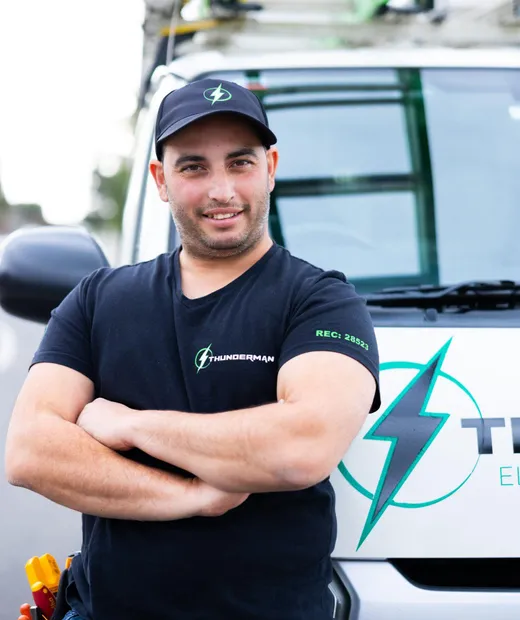
You'll get Yiannis — not a subcontractor.
Book Thunderman and the licensed electrician who quotes your job is the one who does it — and stands behind it afterwards. REC 28523, ARCtick certified, fully insured, rated 4.9★ across 53 Google reviews.
More from the Journal
Got a follow-up question? Just call.
Free quotes across Greater Melbourne — Yiannis answers personally.