Rewiring an old Melbourne weatherboard: what's actually involved
Cloth-covered wiring, ceramic fuses, no earth — old weatherboard homes need rewiring. Here's what to expect, from the signs to the staged-vs-full decision.
Quick answer
Open your switchboard. If you see ceramic rewireable fuses, no safety switch, or you’ve spotted cloth-covered cable in the roof, your home almost certainly needs rewiring or at minimum a thorough inspection. The job is staged or full depending on what the existing wiring looks like. Either way, it’s licensed electrical work — not a DIY job.
The signs that old wiring is failing
Weatherboard homes built before the mid-1960s — and there are a lot of them in Brunswick and Coburg — were typically wired with rubber-insulated, cloth-covered cable. The rubber has usually been degrading for decades by now. It becomes brittle, cracks, and eventually exposes bare conductors. That’s not a cosmetic issue. That’s a fire risk.
Here are the things worth looking for:
Ceramic rewireable fuses. The old-style switchboard has a row of small ceramic cartridges, each with fuse wire threaded through it. When a circuit overloads, the wire melts — which is the protection mechanism. The problem is that people replace blown fuse wire with whatever they have handy, sometimes heavier wire that won’t blow at all. A circuit that should trip at 15 amps might now run at 30 without any protection. That’s a red flag.
No safety switch (RCD). A safety switch — also called a residual current device — cuts power in milliseconds if it detects current leaking to earth (including through a person). They’re now required by AS/NZS 3000 on power and lighting circuits in new work, and Energy Safe Victoria recommends them in all homes. An old switchboard with ceramic fuses almost certainly has none.
Cloth-covered or rubber-insulated wiring. If you can see into your roof cavity or under your floor, look at the cables. Modern cable has PVC sheathing, usually white or grey. Old wiring looks like twisted fabric cord, sometimes black, sometimes the colour of old newspapers. The insulation on that wiring is not rated for another decade of use.
No earth conductors. Older two-wire systems ran only active and neutral — no earth. That means your power points have nowhere to send a fault current except through whoever’s touching the appliance. This is why old wiring without earth is a serious hazard, not just a compliance footnote.
Lights that flicker, power points that spark, or a burning smell with no obvious source. These are symptoms of deteriorated insulation or loose connections. Don’t leave them sitting there.
If more than one of these applies to your home, an inspection by a licensed electrician is the sensible next step. Energy Safe Victoria recommends that older electrical installations be checked.
Staged rewire versus full rewire — what’s the difference
A full rewire means replacing every circuit from the switchboard out: power, lighting, oven, hot water, and so on. All the old cable comes out (or is safely isolated), new cable goes in, and the switchboard is replaced with a modern unit fitted with circuit breakers and safety switches. The house ends up with a clean, compliant, documented installation.
A staged rewire means tackling the worst circuits first, then working through the rest over time. It’s a common approach for occupied homes where budget or disruption is a constraint. The priority order is usually: safety switch installation first, highest-risk circuits (kitchen, bathroom, wet areas) second, then the remaining power and lighting circuits.
The honest caveat: a staged approach only works if the wiring being left temporarily is still in a condition where it can be safely energised. If the whole installation is deteriorated, a partial rewire may just delay the inevitable — and in some cases, disturbing old wiring to run new cable can expose how fragile the remainder is. A licensed electrician needs to assess what’s there before recommending a path.
Weatherboards and insulation — a complication worth knowing about
Many older weatherboard homes have had bulk insulation blown into the wall cavities or ceiling over the years. That’s generally a good thing for energy efficiency. But it complicates rewiring.
Old wiring in an insulated ceiling cavity runs hotter than the same cable in open air — insulation reduces heat dissipation. If the cable rating was marginal to begin with, insulation can push it into an unsafe operating range. AS/NZS 3000 sets derating requirements for cables in insulated spaces, so new cable needs to be selected and installed with that in mind.
The practical issue during a rewire: pulling old cable out of a ceiling that’s been blown full of loose-fill insulation is messy and time-consuming. It’s also necessary — abandoned old cable in an insulated space is a latent hazard. Expect this part of the job to take longer than the same work in an uninsulated roof.
For residential electrical work in older Melbourne homes, understanding what’s inside the walls and ceilings before quoting is part of doing the job properly. Any electrician who quotes a weatherboard rewire without looking in the roof space first is guessing.
What happens at the switchboard
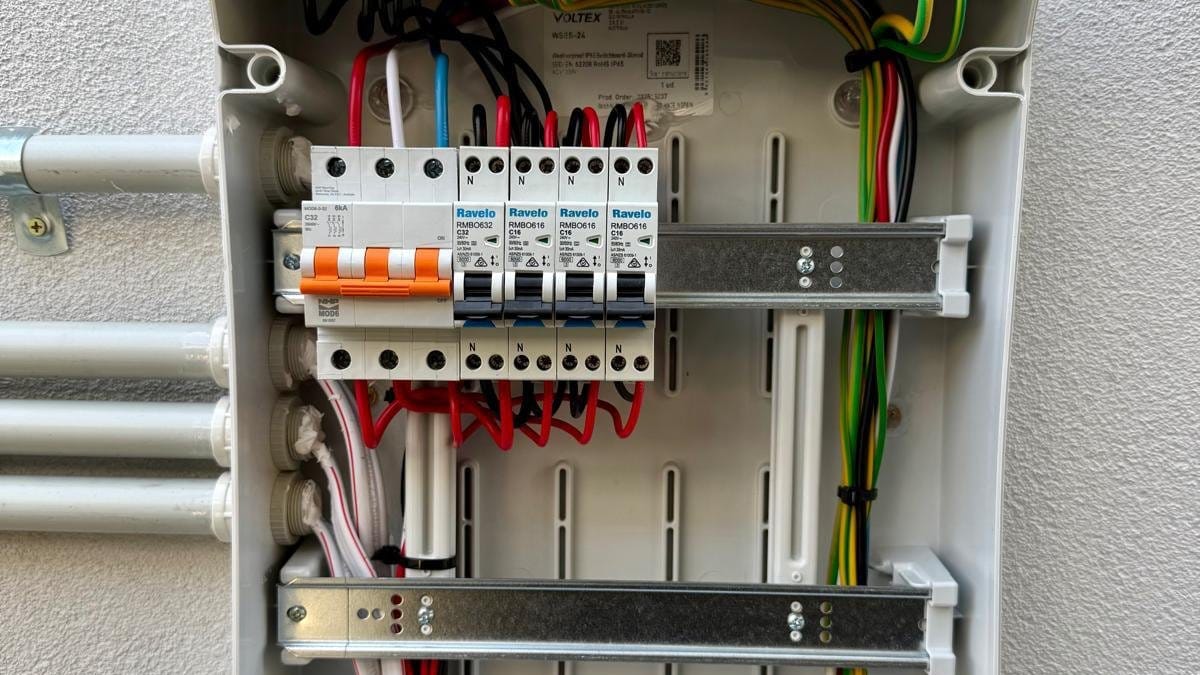
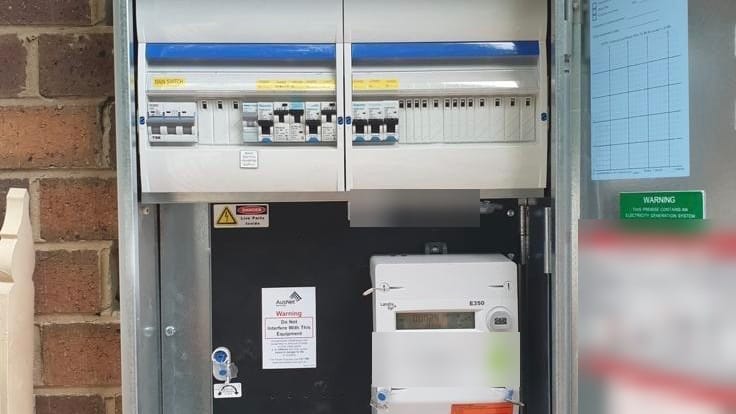
Replacing an old fuse board is almost always part of a rewire, and it’s one of the higher-value parts of the job. A modern switchboard includes:
- Circuit breakers on every circuit (these reset — you don’t need fuse wire)
- At minimum one safety switch covering power points; ideally safety switches on lighting circuits too
- Surge protection in some installs
- Clearly labelled circuits so the next person working on the board knows what’s what
The new switchboard is where the house’s safety infrastructure lives. Getting it right matters.
Notification and paperwork
Electrical work in Victoria is regulated by Energy Safe Victoria. After installation work is complete, a licensed electrician must issue a Certificate of Electrical Safety — this is the legal document confirming the work has been done to the Wiring Rules standard. It’s not optional and it’s not the same thing as an invoice.
Keep your CoES. You’ll need it if you ever sell the property, if your insurer asks about the install, or if future electrical work needs to reference what’s there.
One clarification on council: electrical work in Victoria does not go through your local council — notification goes to ESV via the CoES system. Building permits are a separate question and depend on whether the scope of the project triggers one under the National Construction Code; your electrician can advise. But don’t confuse “council approval” with “electrical compliance” — they’re different things under different legislation.
You can verify any Victorian electrician or contractor on the ESV public register — Yiannis holds REC 28523.
What to do next
If your home has cloth-covered wiring, ceramic fuses, or no safety switch, start with a proper inspection. Don’t try to assess the condition of old wiring yourself — some of it looks fine until it’s handled, and handling deteriorated rubber insulation can make things worse.
Switch off circuits you’re concerned about at the switchboard if it’s safe to do so, then leave them off until a licensed sparky can look at them.
Have a look at your switchboard and note what you see: circuit breakers or ceramic fuses, whether there’s a safety switch (usually labelled “RCD” or “Safety Switch”), and how many circuits are running off it. That information helps when you call.
If you’d rather a licensed sparky handle it from here, give Yiannis a call on 0434 254 474 or send a quick message for a free quote.
Sources
- Energy Safe Victoria — household wiring and safety switches
- Energy Safe Victoria — about Certificates of Electrical Safety
- AS/NZS 3000:2018 — Wiring Rules
Common questions
How do I know if my weatherboard home still has old wiring?
Look at your switchboard. If you see ceramic rewireable fuses (small white cylinders with fuse wire through the middle) instead of circuit breakers, that's a strong indicator. Cloth-covered cable anywhere visible — in the roof space, under the floor — is another clear sign. No safety switch (RCD) on the board is a third.
Is old wiring automatically illegal?
Not automatically — but it must be safe. If the wiring is deteriorated, undersized for modern loads, or lacks earth conductors, it's a hazard regardless of age. Energy Safe Victoria recommends older installations be inspected by a licensed electrician. Any wiring work done today must comply with AS/NZS 3000.
Does rewiring a home need council approval?
Electrical work in Victoria is notified to Energy Safe Victoria through a Certificate of Electrical Safety, not through your local council. Building permits are a separate consideration — your licensed electrician can advise whether the scope of work triggers one.
Can a rewire be done while we live in the house?
Yes, a staged rewire is common for occupied homes. Yiannis can work room by room, restoring power to each section before moving on, so you're rarely without power to the whole house at once. Some days will be disruptive, but a full move-out isn't usually necessary.
Will rewiring damage my plaster ceilings and walls?
Some access is always needed — typically in the roof cavity, under the floor, and occasionally through walls. An experienced electrician minimises penetrations and patches where needed, but it's honest to say some cosmetic repair is usually involved. The alternative — living with failing wiring — is a much bigger problem.
What is a Certificate of Electrical Safety and do I get one?
A Certificate of Electrical Safety (CoES) is a legal document your licensed electrician must issue after completing installation work. It confirms the work meets the Wiring Rules and has been inspected. Keep it — you'll need it for insurance and future sales.
The owner does your job
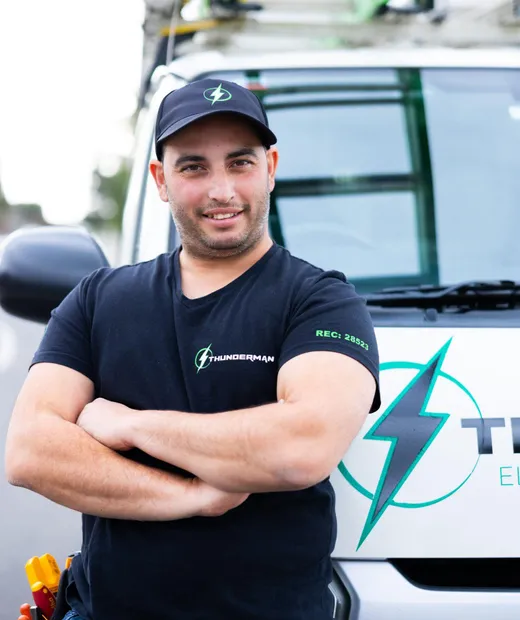
You'll get Yiannis — not a subcontractor.
Book Thunderman and the licensed electrician who quotes your job is the one who does it — and stands behind it afterwards. REC 28523, ARCtick certified, public liability insured, rated 4.9★ across 53 Google reviews.
More from the Journal
Got a follow-up question? Just call.
Free quotes across Greater Melbourne — Yiannis answers personally.