ESV warning: crane near powerlines causes serious incident in Victoria
Energy Safe Victoria has issued an urgent powerline warning after a serious crane incident. Here's what it means for Melbourne homeowners and construction sites near overhead lines.
Quick answer
Energy Safe Victoria issued an urgent warning on 13 October 2026 after a serious crane incident involving overhead powerlines in Victoria. Construction sites, tree work, and any elevated plant near overhead lines carry real electrocution risk. If you’re near a construction site, or have a tree job or aerial work planned at your property, stop and get proper advice before anything moves near those lines.
What ESV actually said — and why it matters today
Yesterday afternoon, Energy Safe Victoria published a formal incident warning after a crane made contact — or came dangerously close — with overhead powerlines at a Victorian worksite. ESV doesn’t issue these alerts for paperwork’s sake. When they put a warning out, it’s because something serious happened and they want to stop it happening again before the week is out.
Cranes, elevated work platforms, tip trucks with raised trays, and even long irrigation pipes are involved in powerline contact incidents every year across Australia. The electricity in a standard overhead distribution line is enough to kill instantly, and it can arc across a gap — you don’t have to actually touch the wire for the current to reach you.
If you work in construction or plant hire, share this with your team. If you’re a homeowner in a suburb where development is active — and in Greater Melbourne right now, that’s most of them — it’s worth knowing what to watch for.
Why overhead powerlines are more dangerous than they look
Most overhead lines running through Melbourne suburbs are not insulated in the way your household wiring is. The ones that run along your street on timber poles carry voltages that would be fatal on contact, and they don’t have the kind of protection that would safely stop a crane boom or a tree branch from conducting that energy straight to the ground — and to anyone standing nearby.
There are a few things that catch people out:
- Height is easy to misjudge. A crane operator in a cab, or a bobcat driver on a sloped block, can lose track of vertical clearances quickly. Lines that look high from the street may be much lower than assumed once you’re elevated or working on a slope.
- Loads swing. A crane boom at a safe distance can swing a load into a line. Wind doesn’t help.
- There’s no visual warning. An energised line looks identical to a de-energised one.
- Arcing happens before contact. At high voltages, current can jump through air to reach plant, equipment, or a person — the physical gap is not the safety margin people assume it is.
ESV’s role here is to regulate electrical safety in Victoria, and under their remit, incidents like this trigger formal investigations. They also coordinate with WorkSafe Victoria on worksite duties. Both agencies can issue improvement notices and prohibition notices — meaning a site can be shut down on the spot if powerline safety isn’t managed properly.
What the rules actually require on a Victorian worksite
Before any crane, elevated work platform, or large plant operates near overhead lines, there are legal obligations in play — not suggestions. The principal contractor on a site is required to identify overhead powerlines as a hazard in the site’s safety documentation. The plant operator has their own duty of care. And critically, the line owner (usually the local network distributor) must be notified and consulted before work begins within the required exclusion zone.
What that exclusion zone looks like depends on the voltage of the line. Don’t guess the voltage from the size of the cable. Get it confirmed by the distributor.
A job that’s been planned properly will have:
- A written safe work method statement that specifically addresses powerline proximity
- Confirmed safe approach distances from the line owner
- Spotters in place if plant is operating near lines
- A clear communication plan between the crane operator and the ground crew
If you’re the homeowner and a contractor is working on your property near street-level lines, it’s reasonable to ask them whether they’ve notified the distributor. A good contractor won’t take offence. A contractor who brushes off the question is one to watch.
For Melbourne homeowners: what this warning means near your property
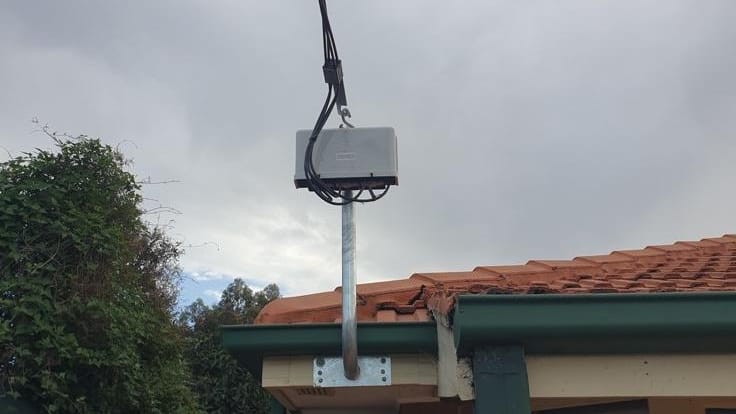
You don’t have to be running a construction site for this to be relevant. In suburbs like Epping and Broadmeadows, older housing stock sits next to new medium-density development. Tree work, roof jobs, antenna installs, and skip bin deliveries all involve elevated equipment — sometimes closer to street powerlines than anyone has thought through.
Here are the practical situations where a Melbourne homeowner needs to pause and check:
Tree removal or pruning near the street. If your tree or your neighbour’s tree hangs near overhead lines, that work needs more than just a tradie with a chainsaw. Depending on the line type and the proximity, you may need the distributor to come and de-energise or reposition the line, or at minimum, supervise the work. This is not a DIY call under any circumstances.
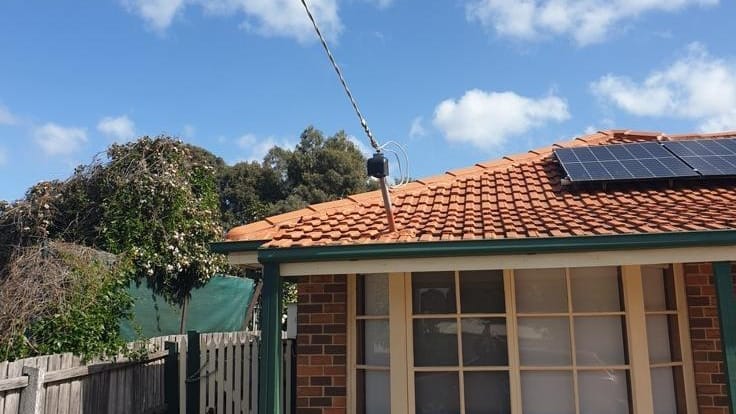
Roof work, guttering, or antenna installs. Scaffolding, ladders, and long metal poles can all reach dangerous heights. Make sure whoever is doing the work has looked at where your service line enters the house and planned around it.
Skip bins and delivery trucks. Tipper trucks with raised trays and crane-mounted delivery vehicles have caused powerline contacts at residential properties. A truck driver raising a tray without looking up is a real scenario.
Your general electrical installation and switchboard. If something upstream of your meter is damaged because a line was struck near your property, call a licensed electrician before you reset anything or assume the fault is resolved. The kind of surge or disruption caused by a powerline contact can damage wiring inside the house even if everything looks normal from the outside. ESV guidance on household wiring and safety switches is worth reading if you’re unsure what to check.
If something looks wrong right now
If you see plant or equipment operating close to overhead lines in your street and it doesn’t look right — stop and think before you approach. An energised line on the ground, or a crane boom tangled in a line, is a 000 call. Don’t get closer. Don’t try to help someone who may already be in contact with a live conductor.
If the situation isn’t an immediate emergency but you want to report a safety concern, ESV takes reports from the public. A licensed electrical contractor — REC number visible on their vehicle or paperwork — can also help you understand what’s going on with your own installation if you suspect damage.
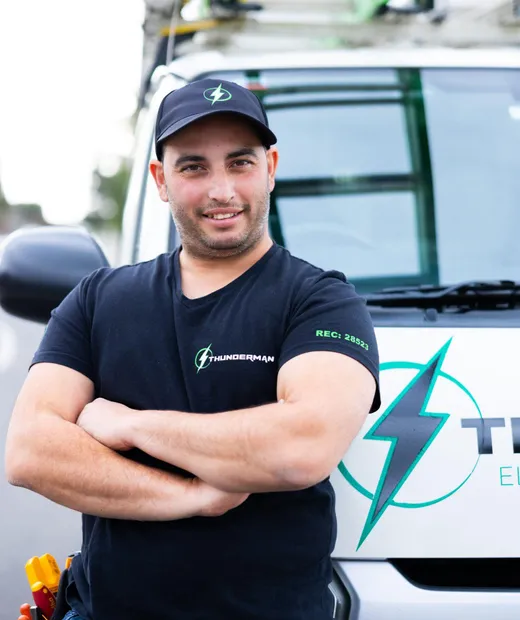
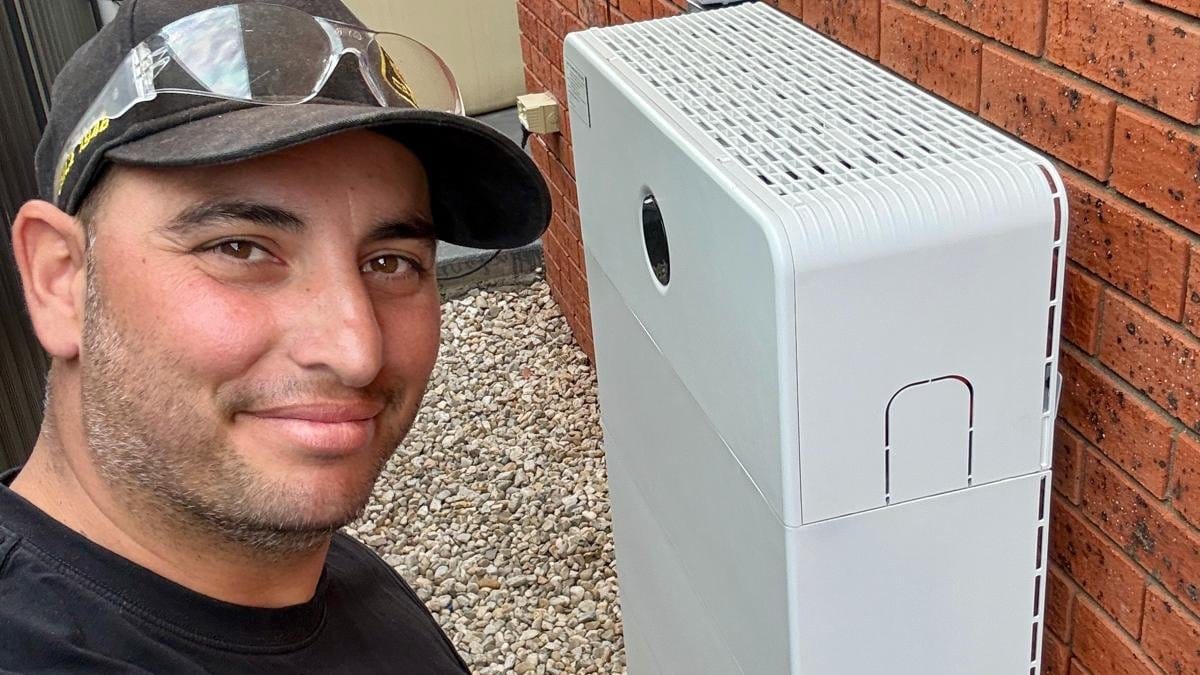
Yiannis holds REC 28523 (verifiable on the ESV public register) and covers Greater Melbourne. If you’ve had construction work near your property and you’re not confident everything is fine with your wiring, it’s worth getting it looked at. Licensed electrical work in Victoria requires a Certificate of Electrical Safety — that’s the document that confirms the work was done correctly and that the installation is safe.
What to do next
ESV’s warning is a timely reminder that powerline safety isn’t just a worksite issue — it follows the lines wherever they go, which is through every Melbourne street and past every back fence. If you’re planning any work near overhead lines at your property, contact your electricity distributor first and factor the powerline location into the job scope before anyone turns up with a ladder.
If you’re a landlord, owner-builder, or small business with a site in Greater Melbourne, it’s worth reviewing your safety documentation to confirm powerline proximity has been assessed as a hazard.
If you’d rather a licensed sparky take a look at your electrical installation or talk through what’s safe to do near your service lines, give Yiannis a call on 0434 254 474 or send a quick message for a free quote.
Sources
Common questions
How close can a crane or elevated work platform get to powerlines in Victoria?
Safe approach distances depend on the voltage of the line and are set by WorkSafe Victoria. For standard overhead distribution lines, the minimum no-go zone without a formal safety plan is typically several metres. Never assume a line is low-voltage or safe — contact the line owner and your safety officer before any work near overhead lines.
Who is responsible for safe work near powerlines on a construction site?
Both the principal contractor and the plant operator share legal duties. ESV and WorkSafe Victoria both have jurisdiction. The line owner (usually the local distributor) must be notified before work begins within the required exclusion zone.
What should a homeowner near a construction site do if they're worried about powerline safety?
If you see plant or equipment operating close to overhead lines next door or in your street, and something looks wrong, call 000 for an emergency or contact ESV directly. Don't approach any equipment or line that may be energised.
Do the powerline safety rules apply to trees and vegetation near overhead lines on my property?
Yes. Cutting trees or large branches near overhead lines is not a DIY job. In Victoria, that work requires coordination with the line owner, and in many cases a licensed electrician or authorised person needs to be involved. Call Yiannis on 0434 254 474 if you're unsure.
What is a Certificate of Electrical Safety and does powerline work require one?
A Certificate of Electrical Safety (CoES) is required for most electrical installation work in Victoria. Any work that involves connecting to or modifying an electrical installation near the network must be carried out by a Registered Electrical Contractor who issues a CoES on completion.
The owner does your job
You'll get Yiannis — not a subcontractor.
Book Thunderman and the licensed electrician who quotes your job is the one who does it — and stands behind it afterwards. REC 28523, ARCtick certified, public liability insured, rated 4.9★ across 53 Google reviews.
More from the Journal
Got a follow-up question? Just call.
Free quotes across Greater Melbourne — Yiannis answers personally.