
EV charger installation in Victoria: what's legal, what's smart
The Victorian rules for home EV chargers — 7 kW vs 22 kW, switchboard questions, certification, and what to ask before you book.
Quick answer
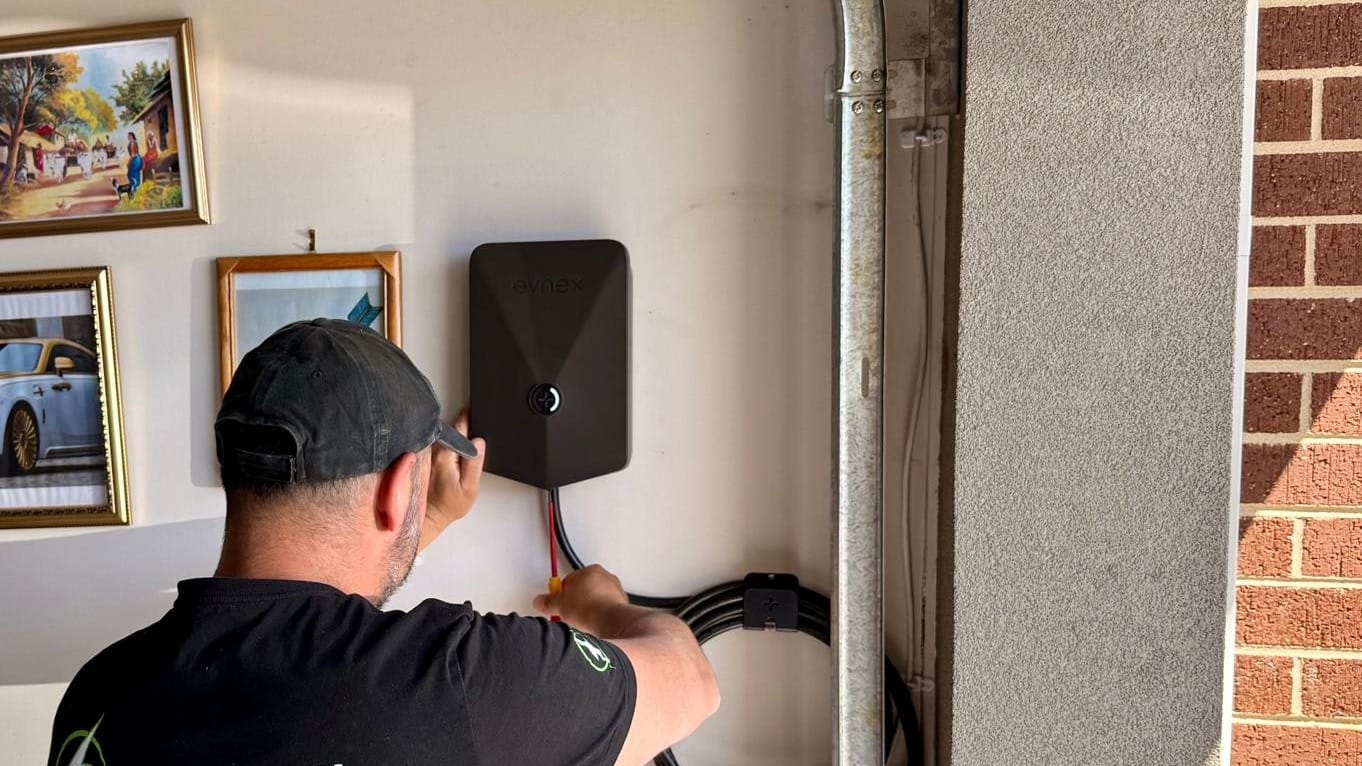
A home EV charger in Victoria has to be installed by a Registered Electrical Contractor and certified with a Certificate of Electrical Safety. For most households a 7 kW single-phase wall unit on a dedicated circuit is the right answer — fast enough for overnight charging, simple to install, no switchboard heroics required. Three-phase 22 kW is for the small slice of households with two EVs, three-phase already at the meter, and EVs that accept that much AC.
What the law actually requires in Victoria
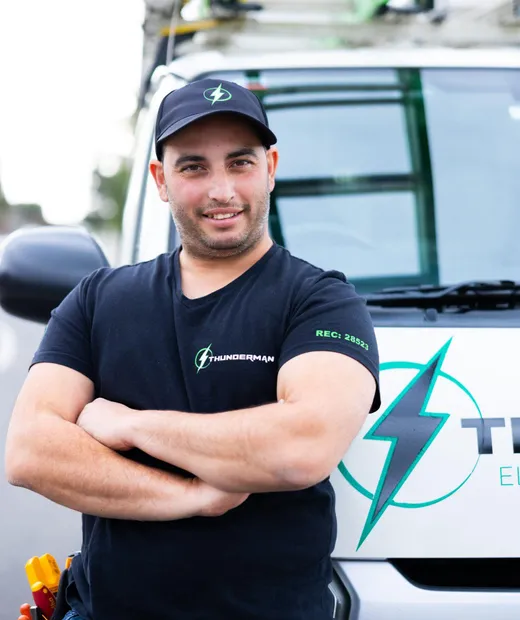
Every fixed electrical install in Victoria — and that includes any wall-mounted EV charger that wires into the supply — must be done by a Registered Electrical Contractor (REC) and signed off with a Certificate of Electrical Safety lodged with Energy Safe Victoria. This isn’t a suggestion. Energy Safe Victoria registers the contractor and enforces the standard — Yiannis holds REC 28523 on that register, and you can look it up.
What that means in practice:
- The person doing the work must hold a current Victorian REC. Their number should appear on the quote and the certificate.
- The install has to comply with AS/NZS 3000 (the Wiring Rules), specifically the sections covering dedicated EV supply equipment.
- A Certificate of Electrical Safety (CoES) is issued and lodged. You should get a copy. This is your proof the install is legal — house insurance, future buyers, and any subsequent electrical work will all ask for it.
- For chargers above a certain current rating, the local distribution network operator (Citipower, Powercor, Jemena, AusNet, United Energy — depending on your suburb) may need to be notified. The sparky handles this.
A surprising number of EV chargers sold online come with “DIY install” YouTube videos. They are not legal in Victoria for any installation that goes beyond plugging a portable cable into a power point. A non-compliant install voids the charger warranty, voids your home insurance for any related claim, and exposes you to fines if discovered.
7 kW or 22 kW — the decision that drives everything else
Every other install question follows from this one.
A 7 kW charger uses single-phase 32 A supply — the supply most Australian homes already have. It delivers roughly 40 km of range per hour of charging. Plug in at 6 pm with a half-empty battery; the car is full by morning. For 95 percent of Greater Melbourne households, this is the right answer.
A 22 kW charger uses three-phase 32 A supply. It delivers roughly 120 km of range per hour — three times faster. Two things have to be true for it to make sense:
- You actually have three-phase power at the meter. Most established suburban homes don’t — they’re single-phase only. Adding three-phase from the street is a serious job, sometimes a major one, sometimes practically impossible depending on the supply infrastructure.
- Your EV can accept 22 kW AC. This is the bigger gotcha. Most EVs sold in Australia accept a maximum of 7–11 kW on AC. The car has the onboard charger that limits the rate; a 22 kW charger feeding a 7 kW-limited car charges at 7 kW. Buying a 22 kW charger for a car that can’t use it is paying for nothing.
The honest sparky answer for the majority of Brunswick and Craigieburn homes installing their first home charger: single-phase 7 kW on a dedicated circuit. It’s simpler, cheaper, fits the existing switchboard, and matches what your EV actually accepts.
The exceptions: households with two EVs charging on the same evening, owners of newer European EVs that genuinely accept 22 kW AC, or homes already wired three-phase for other reasons (a workshop, ducted reverse-cycle, big pool pump).
What a proper install looks like
A compliant EV charger install has the following bits:
- A dedicated circuit from the switchboard to the charger location. EV chargers run at sustained high current for hours; they cannot share a circuit with general power.
- The right cable size for the run length and load. Long cable runs (more than about 30 metres) often need an upsize to avoid voltage drop.
- A safety switch (RCD) of the correct type — Type B or Type A+ for chargers, because EVs can cause DC residual currents that a standard Type AC RCD won’t detect. This is a recent code change a lot of older installs missed.
- An isolator within sight of the charger, weatherproof if outdoor.
- The charger itself, mounted at the right height, with proper cable management, and properly weatherproof if mounted outside.
- The CoES issued and lodged.
A quote that doesn’t itemise these things is either skimping or assuming. Ask. A good solar and battery contractor — EV charging is increasingly handled by the same trade — will walk you through each one before they take a deposit.
The switchboard question
For an older home, the install conversation often goes off-script the moment the sparky looks at the switchboard. Common findings:
- No spare positions. The board is full. Either install a sub-board for the new circuit, or upgrade the whole switchboard.
- No main switch RCD, no per-circuit RCDs. Older homes built before the 2007/2018 code revisions sometimes have only the bare minimum protection. EV charging is a great trigger to bring the whole board up to current standard.
- Ceramic fuses still in use. Time for an upgrade regardless.
- Tight on capacity. The total household demand is already close to the supply rating. Adding a 7 kW charger that runs for hours might push it over. Sometimes solvable with dynamic load management (the charger monitors total household load and throttles itself); sometimes solvable with a supply upgrade from the distributor.
Each of these is fixable. None is a reason not to install a charger. They’re reasons not to be surprised by the second-quote line item that wasn’t on the first quote.
Pairing with solar — and being honest about it
Most EV owners with solar want the car to charge from rooftop generation during the day. That requires:
- A smart charger that can communicate with the solar inverter or with a CT clamp on the mains.
- A scheduling or surplus-tracking mode in the charger — only draws from solar export, or only charges between certain hours.
- The infrastructure to communicate: usually OCPP-compatible chargers, Modbus to the inverter, or an energy-management system on the home network.
When it works, it’s beautiful: the car charges for free on a sunny Sunday afternoon while you’re out. When it doesn’t, it’s because the charger and inverter speak different protocols or were never properly commissioned together.
If solar matching matters to you, get the charger and the inverter from compatible vendor families, and tell the sparky upfront. Designing it at install time is straightforward. Retrofitting it later is annoying.
Questions to ask before booking
- What’s your Victorian REC number?
- What size and type of RCD will you install on the new circuit?
- Will you need to upgrade the switchboard, and if so, what’s involved?
- Is the supply single-phase or three-phase, and which charger size do you recommend for our cars?
- Do we need the distributor (Citipower / Powercor / Jemena / AusNet / United Energy) notified for this install?
- Will the install support solar surplus charging, and if so, how?
- Will you lodge the Certificate of Electrical Safety, and will I get a copy?
A sparky who answers these confidently, with specifics tied to your actual house, is the one to book.
What to do next
Decide whether 7 kW single-phase or 22 kW three-phase is right for your household (for most homes: 7 kW). Photograph your switchboard. Note where the car parks and where the cable would need to run. Once you know what’s legal and which charger suits you, the next question is usually the money side — what actually moves an EV charger install quote in Victoria walks through the six cost drivers. If you’d rather a licensed sparky who handles EV chargers across Greater Melbourne walk through the install with you, give Yiannis a call on 0434 254 474 or send a quick message for a free quote.
Sources
- Energy Safe Victoria — public register of electrical licences
- Energy Safe Victoria — Certificates of Electrical Safety
- AS/NZS 3000:2018 — Wiring Rules
- AS/NZS 3112 — Plug and socket-outlets
Common questions
Do I legally need an electrician to install a home EV charger in Victoria?
Yes. Any installation that connects to the electrical supply must be done by a Registered Electrical Contractor under Victorian law and certified with a Certificate of Electrical Safety lodged with Energy Safe Victoria. A plug-in granny cable into an existing power point isn't an install — but any wall-mounted dedicated charger needs a licensed sparky and proper certification.
What's the difference between 7 kW and 22 kW charging at home?
A 7 kW charger uses single-phase power and is what most Australian homes have available. It's plenty for overnight charging — a typical EV gains around 40 km of range per hour. A 22 kW charger needs three-phase power and only some EVs can accept that much AC charging. For most households on a typical commute, 7 kW is the right answer and 22 kW is overkill — unless you're running two cars or have unusual driving patterns.
Can I just plug my EV into a regular power point?
Technically yes — every EV comes with a portable cable that fits a standard 10 A power point. Practically it's slow (about 10 km of range per hour) and the cable will stay plugged in for many hours at a time. That's a sustained load most house power points were not designed to carry continuously. A dedicated EV charger on its own circuit is safer, faster, and the sensible long-term answer.
Will I need a switchboard upgrade?
Often, but not always. A modern switchboard with spare capacity and an unused slot can usually accept a new EV circuit. An older board with no spare positions, no main switch RCD, or running near its capacity will need upgrading first. A sparky can tell you in five minutes on a site visit — and we always check before quoting an install.
What about pairing the charger with solar?
Smart chargers can talk to your solar inverter and only draw from rooftop solar surplus — meaning the car charges on free electricity during the day. That's brilliant if you're home during the day or work shift. The catch is that the charger, inverter, and any energy management system all need to be on the right protocols (Modbus, OCPP, OpenEVSE), and that's worth designing properly at install time rather than retrofitting later.
The owner does your job
You'll get Yiannis — not a subcontractor.
Book Thunderman and the licensed electrician who quotes your job is the one who does it — and stands behind it afterwards. REC 28523, ARCtick certified, fully insured, rated 4.9★ across 53 Google reviews.
More from the Journal
Got a follow-up question? Just call.
Free quotes across Greater Melbourne — Yiannis answers personally.