Solar output has dropped: how an electrician works out why
Spring should be lifting your solar production, not flattening it. The usual causes of a genuine drop, the ones that are only a monitoring artefact, and where the roof stops being your job.
Quick answer
Before assuming a fault, compare the same month against the same month a year ago. If the drop is real, the usual causes are shading that has grown, soiling on the panels, a string or connection fault, or an inverter reducing output because of a grid voltage condition. Diagnosis belongs to a licensed electrician. Nobody should be on the roof to investigate it themselves.
Spring is when you notice
Solar output follows the sun angle, and in Melbourne that means the curve is climbing steeply through September and October. Which is exactly why this is the time of year the phone rings about it. You look at the app, you see a number that is not moving up the way it did last spring, and you start wondering.
That instinct is right. A system that is not lifting as the days lengthen is telling you something. But before anyone climbs anything, there is a question worth settling: is the drop real?
The comparison that means something
Most people compare this week to last week, or this month to last month. Neither tells you much. Cloud cover alone will swamp the signal, and the sun angle changes week to week anyway.
The comparison that means something is the same month, this year against last year. September against September. If the two are close, the system is fine and the weather was different. If September is well down on last September, you have a genuine change to explain.
Two more things to check before calling it a fault. First, has anything changed on your side of the meter, like a new appliance running through the day that is quietly consuming what used to be exported? If you are reading exported energy rather than generated energy, a change in your own habits looks exactly like a production problem. Second, has the monitoring itself dropped out? Losing the internet connection to a monitoring portal produces a chart that looks alarming and means nothing at all. That one accounts for a fair number of worried calls.
The four things that genuinely cause it
Once the drop is confirmed, the causes sort into four groups, roughly in order of how often they turn up.
Shading that was not there before. Trees grow. A neighbour’s extension goes up. A new antenna or a flue gets installed. Depending on how the array is wired and whether panel-level electronics are fitted, shade across a corner of one panel can drag down more than just that panel. Worth doing once: stand in the yard at about nine in the morning and again at four in the afternoon, in the season you care about, and look at where the shadows actually fall. Morning and afternoon shading is easy to miss because most people only ever look at the roof at midday.
Soiling. Dust, pollen, salt, bird mess and the film that builds up near a busy road all cut the light reaching the cells. Rain deals with a good deal of it. It does not deal with the low edge of a panel where grime collects, and it does nothing about lichen. This is a real cause of gradual decline, and it is also the one that tempts people onto the roof with a bucket. Do not. Energy Safe Victoria’s guidance on home solar is unambiguous about leaving the array alone and getting a licensed person to attend to it.
A string or connection fault. Rooftop connectors live outdoors for a decade or more under ultraviolet light and thermal cycling. Isolators fill with water. Connectors of different makes get mated together during a repair and do not seal properly. When a string drops out, the loss is a distinct step rather than a gradual slide, and the shape of the curve on the monitoring is often the first clue as to which of the two you are dealing with.
The inverter reducing output on purpose. This one surprises people. Inverters sold for grid connection in Australia are built to AS/NZS 4777.2, and part of what that standard governs is how an inverter behaves when the voltage at the connection point runs high: it backs its output off, and if the voltage goes far enough outside range it disconnects. In some streets, particularly where there is a lot of solar on the same low voltage feeder, the voltage climbs on sunny afternoons and inverters back off. That is compliant behaviour, not a defect. It is still worth documenting, because the answer may lie with the distributor rather than with your equipment.
Where your job ends
The line is simple and it is not negotiable: the ground is yours, the roof is not.
From the ground you can check the inverter display and note any fault code, look at the monitoring history, watch where shadows fall, and see whether the panels look visibly dirty. All of that is genuinely useful, and a good electrician would rather you arrived with those observations than without them.
Everything above head height, and anything involving the direct current side, isolators or the switchboard, is licensed work. A rooftop array is a height hazard sitting on top of live wiring that cannot be switched off by a single switch the way a normal circuit can. The Clean Energy Council’s consumer guidance makes the same point about using accredited people for solar work, and Energy Safe Victoria runs the public register where you can check any electrician’s registration before you let them near it.
Homes across Craigieburn and through Coburg sit in two quite different solar generations. Newer estate installs tend to be well documented with panel-level monitoring, which makes a string problem quick to isolate. The older retrofits on established roofs often have no documentation at all, and the first job is working out what is actually up there. Both are covered by our solar and battery services, and neither should be diagnosed by guesswork.
What to do next
Pull up the monitoring and compare this month to the same month last year. Write down the inverter’s fault code if it is showing one. Take a photo of the roof from the yard, morning and afternoon.
That handful of information is usually enough to tell an electrician whether they are looking at shading, soiling, a fault or a grid condition before they arrive. What it saves you is a visit spent working out the question rather than answering it.
If you’d rather a licensed sparky handle it, give Yiannis a call on 0434 254 474 or send a quick message for a free quote.
Sources
- Energy Safe Victoria — keeping your home solar safe
- Clean Energy Council — consumer guidance
- Energy Safe Victoria — public register of electrical licences
- AS/NZS 4777.2 — Grid connection of inverters
Common questions
My solar production has dropped. Is the system broken?
Not necessarily. Compare the same month against the same month last year, not against last week. Weather, seasonal sun angle and a single shading change can all move the figure without anything having failed. A drop that shows up year on year in the same month is the one worth investigating.
Should I get up and clean the solar panels myself?
No. Energy Safe Victoria's advice on home solar is to stay off the roof and leave the array to a licensed person. A rooftop array combines height with live direct current wiring, and that is a bad pairing for a homeowner with a hose.
What does it mean when the inverter shows a grid voltage fault?
It usually means the voltage at your connection point went outside the range the inverter is permitted to operate in, so it reduced output or disconnected. That is the inverter doing its job under AS/NZS 4777.2, not failing. If it happens repeatedly, it needs looking into.
Can shading from one tree really matter that much?
It can. Depending on how the panels are wired and what electronics are fitted, shade across part of one panel can pull down more than that panel's share. Trees grow, and a shadow that cleared the roof three summers ago may not clear it now.
Who is allowed to work on a rooftop solar system in Victoria?
Electrical work on a solar installation is licensed work, and accredited design and installation is a separate credential again. Yiannis is a Registered Electrical Contractor, REC 28523, and holds SAA accreditation S6375256 for grid-connected photovoltaic design and install.
The owner does your job
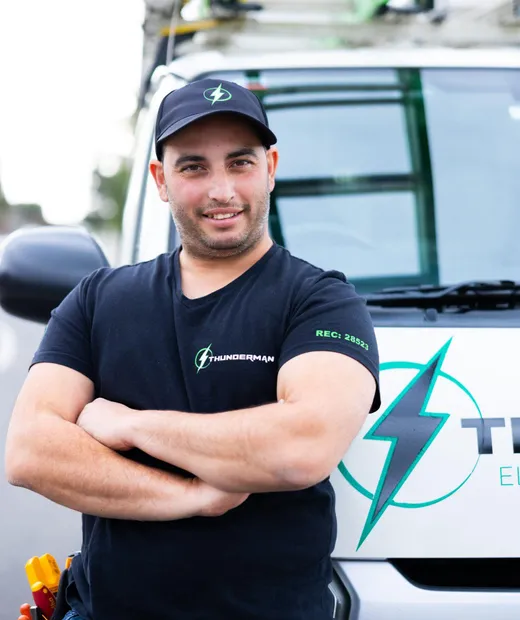
You'll get Yiannis — not a subcontractor.
Book Thunderman and the licensed electrician who quotes your job is the one who does it — and stands behind it afterwards. REC 28523, ARCtick certified, fully insured, rated 4.9★ across 53 Google reviews.
More from the Journal
Got a follow-up question? Just call.
Free quotes across Greater Melbourne — Yiannis answers personally.