
Storm-season safety switches: what every Victorian home should check
Before Melbourne's first big summer storm, a sparky's 10-minute safety-switch check that catches the faults most homes ignore.
Quick answer
Spend ten minutes before the first big summer storm. Press the test button on every safety switch — each one should trip instantly. Walk the outdoor power points and lights for cracks, missing covers, or water tracking. Check the switchboard isn’t running hot or smelling burnt. If anything fails the check, switch it off at the mains and call a licensed sparky.
Why the storm season specifically
Melbourne’s summer brings two things to the electrical system that the rest of the year doesn’t: lightning surges and wind-driven rain. Both are bad news for tired wiring.
A nearby lightning strike doesn’t have to hit your house to cause trouble. The strike induces a voltage surge that travels through power lines, telephone lines, and even data cables — sometimes for kilometres. Modern homes have layers of protection (the network, your switchboard, your appliance) but every layer ages, and a hard surge tests them all at once.
Wind-driven rain finds gaps you never knew you had. A weatherproof outdoor power point that’s been quietly degrading for ten years stops being weatherproof. Water gets behind the rubber seal, tracks across the conductor, and either trips the safety switch or — if there is no safety switch — sits there waiting.
Both problems are completely solvable. They just need someone to look before December.
The 10-minute pre-summer check
1. Test every safety switch
This is the simplest check a homeowner can do without tools, and almost nobody does. Every safety switch has a small T or TEST button. Press it. The switch should trip immediately — the lever flips down, the lights or appliances on that circuit go off. Flip the lever back up to restore power.
If the switch doesn’t trip when you press T, it’s not protecting you. That circuit is running with no shock protection, regardless of what the label says. Don’t try to fix it; call a sparky.
Energy Safe Victoria recommends doing this monthly for every safety switch in the house. Realistically, most people do it once at install and never again. Pre-summer is a sensible reset point.
2. Look at the switchboard
You’re not opening it — you’re just looking. Is there any sign of discolouration on the front panel? A scorch mark? A faint burnt-plastic smell? Is the door warm to the touch when the main power is on?
Any of those is a flag. Switchboards on older Greater Melbourne homes — and there are plenty across Epping and the established northern corridor — sometimes have failing connections that build heat slowly over years. The cabinet runs warm. The plastic starts to brown. Eventually a connection arcs.
If anything looks off, switch the mains off if it’s safe to do so and call a licensed electrician. This is one of those problems that costs nothing to fix early and a lot of money to fix after.
3. Walk the outdoor power points
Every outdoor power point, garden light, and pool pump connection should be in a proper weatherproof enclosure rated to AS/NZS 3000 standards. Check each one:
- Is the cover hinge intact? A drooping cover lets sideways rain in.
- Are there cracks in the housing? UV makes plastic brittle after a decade in the sun.
- Any sign of green corrosion or rust on the metal contacts inside?
- Does the enclosure feel firmly mounted, or does it wobble when you push it?
If something looks weatherbeaten, photograph it and book a sparky. Outdoor electrical work is one of the few places where a small problem in May becomes a tripping safety switch in January.
4. Check antenna and NBN entry points
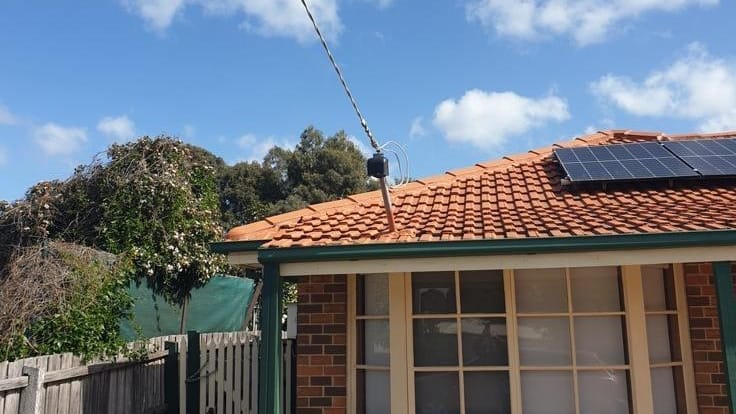
Surges often travel into a house through the antenna lead or the NBN fibre/copper handover, not the main supply. If you have surge protection at the switchboard, it doesn’t cover the antenna or the comms entry — those need their own protection or, ideally, properly bonded earthing.
If you don’t know whether your antenna mast is earthed (most homes don’t have it bonded properly), it’s worth getting a sparky to check during the same visit as everything else.
5. Note anything that’s been “playing up”
The breaker that occasionally clicks off for no reason. The bathroom light that flickers when the toaster runs. The outdoor power point that hasn’t worked since the magpies built a nest near it. Write them down. None of these are critical on a still autumn day. All of them are unwanted variables when there’s lightning rattling the windows.
What a sparky will check that you can’t
If you book a pre-summer inspection — and for any home built before 1995, it’s worth it — a licensed electrician will:
- Test every safety switch with proper equipment — not just the test button, but the actual trip-current threshold and trip time. The internal mechanism wears out; an RCD that takes 80 ms instead of 30 ms to trip might still feel like it’s working, but it’s no longer protecting properly.
- Open the switchboard and look for loose connections, signs of arcing, undersized neutrals, or the wrong type of breaker on a circuit it shouldn’t be on.
- Check the consumer mains and earth. A loose connection where the supply enters the house, or a corroded earth electrode, can both cause subtle problems that only show up under load.
- Test the antenna earth and any surge protection devices if fitted.
- Pull and inspect the most-exposed outdoor points — pool pumps, garden lights, irrigation timers.
The work is straightforward and there’s a residential electrical line item for it. Most homes need nothing beyond a clean bill of health and a few hand-tightened connections. Some homes need a switchboard upgrade — and finding that out in October beats finding out in February when the safety switch finally lets go in a storm.
When the safety switch trips and won’t reset
The drill, from a sparky’s perspective:
- Reset once. Flick the tripped switch back up. If everything works fine and stays fine, you’re done. The switch did its job.
- If it trips immediately on reset: there is an active fault on that circuit. Don’t keep resetting it — that’s not a safety switch problem, that’s a wiring or appliance problem. Unplug everything on the circuit, try resetting again. If it holds, plug things back in one by one to find the culprit. If it still trips with nothing plugged in, the wiring or a built-in light fitting is the problem and needs a sparky.
- If it trips after several minutes: likely a slow-developing fault — moisture, an aging appliance, or a partial wiring breakdown. Call a sparky; don’t keep cycling the switch.
- If multiple switches tripped at once: very likely a surge from a nearby lightning strike or a brief network event. Reset them all once. If they hold, you’re good. If they don’t, you’ve got more than one fault and a sparky needs to find them.
What to do next
Set a calendar reminder for early November every year. Walk the house, press the test buttons, walk the garden, eyeball the switchboard. Ten minutes. Most years you’ll find nothing — that’s the goal. The years you find something, you’ll find it on a calm Sunday morning instead of at 11 pm on a Friday in a thunderstorm. If anything looks off, switch it off at the mains if it’s safe to do so, and give Yiannis a call on 0434 254 474 or send a quick message for a free quote on putting it right.
Sources
- Energy Safe Victoria — household wiring and safety switches
- AS/NZS 3000:2018 — Wiring Rules
Common questions
How often should I test my safety switch?
Energy Safe Victoria recommends pressing the test button on every safety switch once a month. The whole job takes ten seconds per switch — press T, the switch should trip immediately, you flick it back on. If it doesn't trip, that switch is not protecting you and needs a sparky out.
What's the difference between a safety switch and a circuit breaker?
Different jobs. A circuit breaker protects the wiring from drawing too much current and catching fire. A safety switch (also called an RCD or residual current device) protects a person — it cuts the power within milliseconds when current leaks to earth, which is what happens when someone touches a live wire or a faulty appliance. Many homes only have circuit breakers; that's a real gap.
My safety switch trips during thunderstorms — is that normal?
A trip during a big storm is usually one of two things — a nearby lightning strike inducing a surge through the wiring, or moisture getting into an outdoor fitting. Reset the switch once. If it trips again immediately, leave it off and call a sparky. If it trips and resets fine and stays fine, it probably did its job and there's nothing wrong.
Do I need safety switches on every circuit?
Under current rules in Victoria, every general power and lighting circuit in a residence must have safety switch (RCD) protection. Older homes often only have safety switches on the power circuits with lights running on plain breakers. That's legal as long as it predates the rule change — but it's not best practice, and it's worth upgrading.
Will surge protection stop my safety switch from tripping in a storm?
Surge protection and safety switches do completely different jobs. A surge protector clamps voltage spikes — it protects your electronics from the spike. A safety switch protects a person from electric shock. You want both. A whole-house surge protector mounted at the switchboard is the cleanest install and protects everything downstream.
Should I switch my main power off before a big storm?
Not the whole house — leaving the fridge running is fine. But unplugging non-essential electronics during a severe thunderstorm warning is a sensible call, especially for older homes without whole-house surge protection. Anything connected to the antenna or NBN line is particularly vulnerable to surges coming in from outside the property.

The owner does your job
You'll get Yiannis — not a subcontractor.
Book Thunderman and the licensed electrician who quotes your job is the one who does it — and stands behind it afterwards. REC 28523, ARCtick certified, fully insured, rated 4.9★ across 53 Google reviews.
More from the Journal
Got a follow-up question? Just call.
Free quotes across Greater Melbourne — Yiannis answers personally.