
EV charger install — six factors that change the cost in Victoria
What moves the cost of a home EV charger install in Victoria — wallbox size, phase, switchboard headroom, cable distance and load management.
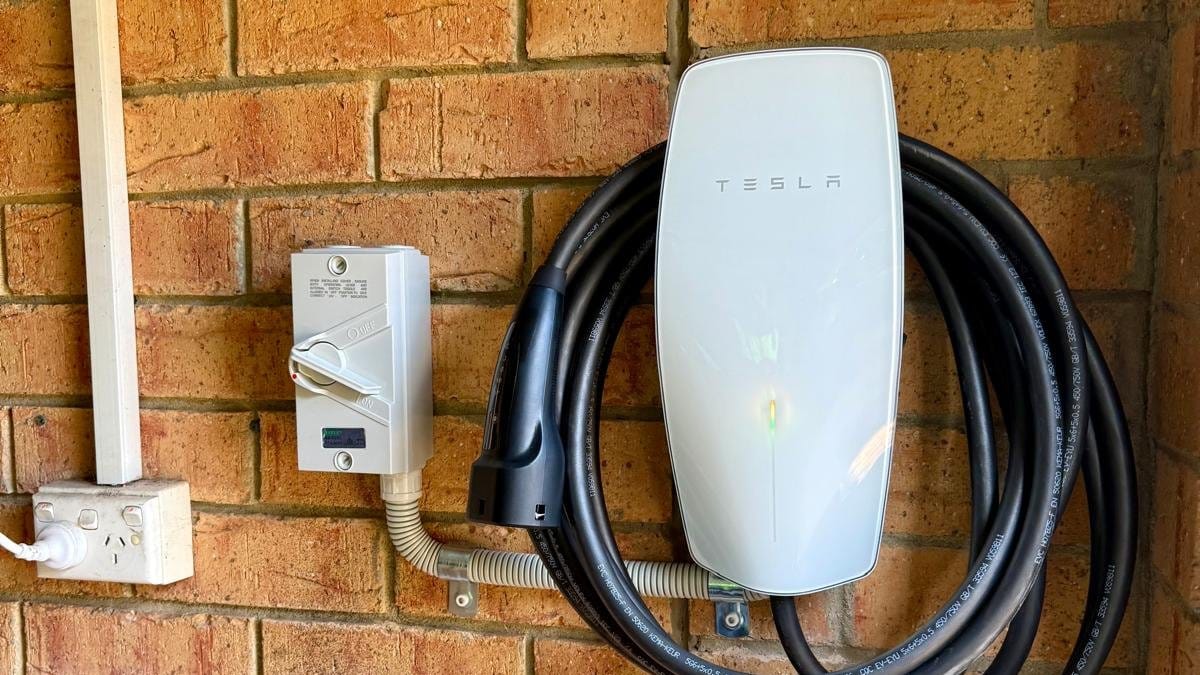
Quick answer
Ask me what an EV charger costs to put in and the honest reply is: I can’t tell you until I’ve seen your switchboard, where you want the wallbox, and the run between the two. Anyone who fires off a number sight-unseen is padding it to cover what they couldn’t see. The wallbox is the cheap bit. What changes the cost house to house is everything around it, and there are six things that do most of the moving: the wallbox size (7 kW vs 11 kW vs 22 kW), whether your supply is single-phase or three-phase, how much spare capacity sits in the existing switchboard, the length of the cable run from the board to the wallbox, the state of the garage or carport it lands in, and how much load-management the household genuinely needs. Below I take each one in turn and tell you which way it pushes the free quote.
Calculator
Quick EV-charger sizing estimate.
A live version of the EV-charger sizing heuristic from the cost-driver post. Gives you a recommended wallbox kW and a cable-run scope bracket — not a final spec or a price. A real Thunderman quote walks the garage, the switchboard and the supply.
Recommended wallbox
—
Fill in the details above to get a sizing recommendation.
Cable-run scope
—
Estimate only — not a fixed spec, and the cable-run bracket is a scope indicator, not a price. AS/NZS 3000 + 4777 require a Type B RCD on every fast-charge EV final sub-circuit. A Thunderman site walk confirms the supply headroom, the cable route and the switchboard scope. Free quote.
Factor 1: wallbox size — 7 kW, 11 kW, or 22 kW
This is the decision that sets up every other line on the quote. A 7 kW wallbox runs off single-phase, puts roughly 40 km of range back per hour, and suits most Greater Melbourne households who plug in overnight and unplug in the morning. Step up to 11 kW or 22 kW and you need three-phase coming in from the consumer pole. The unit itself costs a bit more in the bigger brackets, but that’s not where the money goes. The real swing is what the install has to do to feed it: a 7 kW job often stays inside the existing supply, while a 22 kW box can drag in a phase upgrade and a switchboard rebuild before a single cable gets run. So Factor 1 isn’t really about the wallbox. It’s about what the wallbox commits the rest of the job to.
Factor 2: single-phase or three-phase
Most established homes around Greater Melbourne are single-phase, and that’s plenty for a 7 kW box. New-estate homes — Mernda, Wollert, Donnybrook, the newer pockets of Craigieburn — tend to come with three-phase already in the ground, which makes a fast wallbox almost a drop-in. The cost lives in the gap between those two situations. Want 11 kW or 22 kW on a single-phase home and you’re into a consumer-mains upgrade, and that’s not a job I can do on my own say-so. It means a connection with your local distributor — Citipower, Powercor, Jemena, AusNet or United Energy — and a service-side upgrade booked through them. Doable on most properties. But it’s its own chunk of the quote, and it’s the line that catches people out.
Factor 3: switchboard headroom
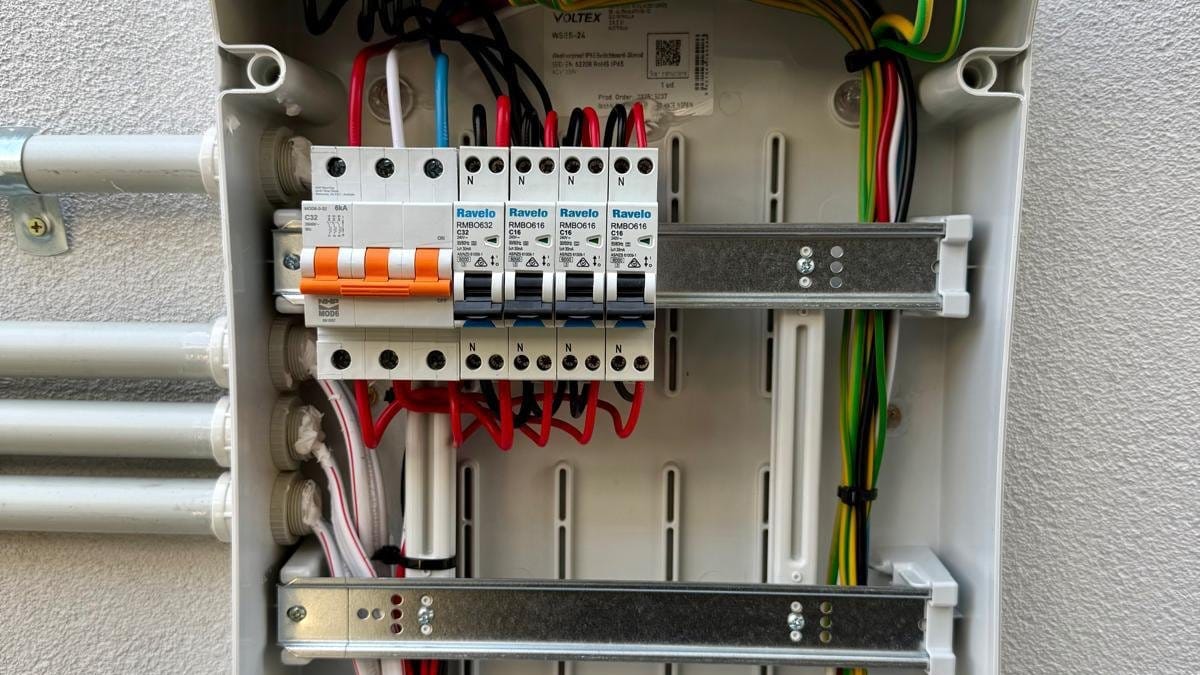
When I open a board, two things decide how much this factor adds. First, is there room on the DIN rail for a dedicated EV sub-circuit with its RCD — often a Type B, because an EV charger can throw DC residual current that a plain Type A won’t catch. Second, has the board got the capacity to carry a 32 A draw on top of whatever the house already pulls. Plenty of older Melbourne boards fail both, and then a re-rate or a full upgrade goes into the job. I’ve covered exactly how that one works out on the quote in the separate piece on switchboard upgrade cost drivers, so I won’t repeat it here. The short version for EV work: a tired board turns a tidy afternoon into a board day, and that shows up on the quote. A post-2018 estate board usually has the spare ways and the spare capacity, and the EV circuit just slots in.
Factor 4: cable run from board to wallbox
Here’s where the hours hide. If the board sits on the garage wall and you want the wallbox a metre away, that’s a quick run and barely registers. Put the wallbox at the far end of a driveway, or in a detached carport with the board on the opposite side of the house, and now you’re looking at a fifty-metre pull. That means trenching, conduit, reinstating the surface afterwards, and a real stack of labour. Long runs also cost more in cable itself, and the heavier the cable the longer it takes to terminate cleanly. When I do a site visit, the first thing I do once I’ve looked at the board is pace out that route. Nothing tells me more about where the number lands, and I’d rather walk it with you than guess at it from a photo.
Factor 5: garage or carport finish state
What the wallbox lands on matters more than people expect. Exposed studs in an unlined garage, and I can run cable in clips and be done. Finished plasterboard, and now I’m fishing walls, cutting access and patching behind me — slower, and the patching is its own bit of work. Take the wallbox outside and the rules change again: weather-rated enclosure, sealed conduit, the lot. Stick it on a pole in the middle of the driveway and you’ve added an outdoor sub-board to feed it. I want to be clear none of this stops the job. It’s just that two houses with the identical wallbox and identical car can quote differently purely on what the charger is bolted to.
Factor 6: load management requirements
Most modern wallboxes can throttle themselves in firmware, easing off the charge rate when the rest of the house is pulling hard — the ducted aircon compressor kicking in on a 38-degree evening, or the oven and induction cooktop both going during dinner. Set up right, that keeps the main from tripping when demand peaks, and it’s a genuinely useful feature. Setting it up right is the catch. It takes time to profile a household’s real loads and tune the charger against them, and on a big house or a three-phase setup running several heavy appliances it stops being a nice-to-have. There it’s the difference between a charger that sits quietly in the background and one that drops the whole house mid-cook.
How I work out the free quote
So all six factors feed one number, and the way I get to it is by going through them on site rather than over the phone. I open the board and check the headroom and the RCD situation. I pace the cable route and look at what it passes through. I settle on the wallbox model and whether the firmware needs configuring. Where a phase upgrade is in play I confirm availability with the distributor before anything is promised. And when the work’s signed off, the Certificate of Electrical Safety gets lodged with Energy Safe Victoria — that’s not optional, it’s how the install becomes legal. The number on the quote is the sum of those checks, with nothing padded in to cover a guess. If you want a sense of the wider job, the residential pillar lays out the broader scope, and the Craigieburn area page covers the local side. For the legal side — what’s actually required in Victoria and which charger is allowed — see the rules for home EV chargers.
Two ways I see people go wrong
I’ll finish on the two shortcuts I see again and again across Victoria, because both cost more than the install they were meant to save on. The first is running the plug-in trickle charger off a household power point as if it’s a permanent setup. A 10 A GPO was never rated for the continuous load an EV pulls night after night. It heats up under that draw, and over months the fire risk is real, not theoretical. Manufacturers pack the trickle lead as an emergency accessory for exactly that reason. The second is the cash-job install: a mate who knows his cable types but holds no REC licence. That one voids the wallbox warranty, falls over at the next house-sale electrical-safety check, breaks Energy Safe Victoria rules, and leaves you with no insurer behind you if anything goes wrong. A licensed install with the Certificate of Electrical Safety on file is what keeps every party covered, and as REC 28523 that’s how I put every one in. Send the wallbox spec and a couple of photos of your switchboard, and I’ll have the quote back to you the same day.
Sources
- Energy Safe Victoria — household wiring and safety switches
- AS/NZS 3000:2018 — Wiring Rules
- New Energy Tech Consumer Code — consumer guides (EV charging)
Common questions
Why does the same EV wallbox cost different amounts at different houses?
Because the wallbox itself is roughly a fifth of the install. The other four-fifths is the cable run from the switchboard, the sub-circuit RCD and circuit protection, the wallbox mounting and weather sealing, the supply capacity assessment, and (often) some level of switchboard re-rate. None of those are constant across houses.
Do I need three-phase for a fast EV charger?
Depends on the charger. A 7 kW wallbox runs on single-phase and is fine for overnight charging — typically adds about 40 km of range per hour. A 11 kW or 22 kW wallbox needs three-phase, and not every Victorian electric vehicle can accept three-phase AC charging at the higher rates. The right call is usually 7 kW for most homeowners, three-phase for the few cases where overnight charging time genuinely matters.
Will I need to upgrade my switchboard for an EV charger?
Often yes, especially on older homes where the switchboard was specified before fast home charging was a residential default. The wallbox circuit needs RCD protection (Type B in many cases), and the board needs headroom for the 32 A draw alongside the household's other major loads. Many older Greater Melbourne homes need a switchboard re-rate or upgrade as part of the install — which is fine, just needs to be in the free quote up-front.
Does Thunderman do load-management firmware setup?
Yes. Most wallboxes ship with firmware that lets the charger throttle when the household supply approaches its limit (the ducted aircon compressor cycling on a hot evening, for example). Configuring the firmware correctly against the household's load profile is part of the install and avoids tripping the main during peak demand.
Are EV charger installs covered by Energy Safe Victoria certification?
Yes. Any install that connects to the electrical supply must be done by a Registered Electrical Contractor and certified with a Certificate of Electrical Safety lodged with Energy Safe Victoria. A non-licensed install voids the wallbox warranty, is illegal under ESV rules, and is a fire risk that no household insurer will accept.
The owner does your job
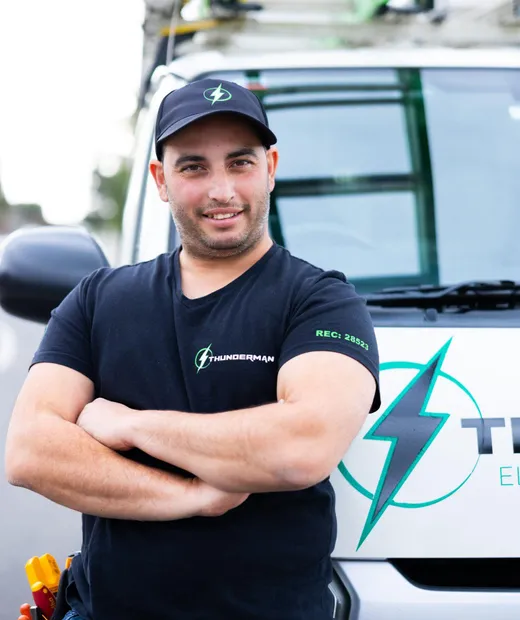
You'll get Yiannis — not a subcontractor.
Book Thunderman and the licensed electrician who quotes your job is the one who does it — and stands behind it afterwards. REC 28523, ARCtick certified, fully insured, rated 4.9★ across 53 Google reviews.
More from the Journal
Got a follow-up question? Just call.
Free quotes across Greater Melbourne — Yiannis answers personally.